


2014 Prostor za razmišljanje Terra Kikinda
SPACE FOR THINKING…
The sky is the opposite of every space — which implies limitation; the sky is what some space abolishes, but at the same time it is its content. However, there is a place where space and the sky touch, intersect — and that is the window — which has its two aspects depending on the time of day — because during the day it is the sky and at night it is a black square. That is why the window is a space for thinking, being a borderline place between the known and the unknown, the limited and the infinite.
In the paintings of Petar Radlović, the meaning of the window as a space for thinking overlaps with another understanding — the painting as a kind of window, i.e. a possible view. Thus, the painting becomes a space for thinking, and the space for thinking becomes a possible view, a vista.
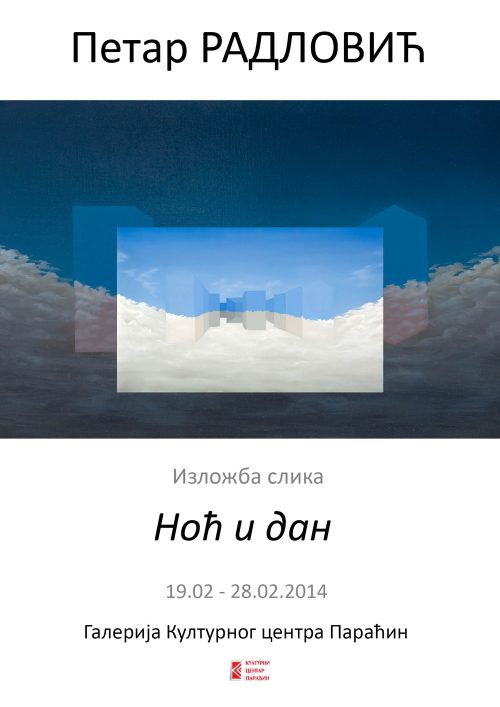
At the same time, Radlović introduces an ironic deviation from the statement that says that someone who immerses himself in himself, in his thoughts, is “in the clouds” by literally painting clouds. He then introduces these fluffy cumulus clouds in the transparent blue sky into a geometrically defined space, thus drawing a boundary to the infinite, i.e., attempting to depict exactly what thought is when we try to articulate it, translate it into a logical system — a framed fragment of a flow. Geometry here serves to stop that flow in order to understand and objectify it.
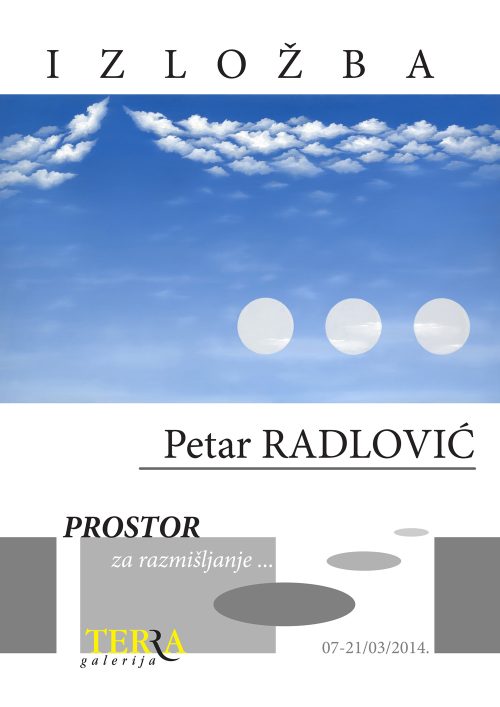
In the painting after which the exhibition was named, Space for Thinking, there is another attempt to represent that flow — the three dots in the lower left corner of the painting are a punctuation mark for something unfinished, for something that, in this case, cannot even be completed. Thus, painting takes over the language of another medium, and moves from description to sign.
At the same time, in addition to the punctuation mark, those three dots contain something else — because in them you can also see those clouds from the picture. They are not three black dots at the end of an unfinished sentence, but dots that, in addition to representing a flow (as a sign of duration), are also that flow itself (and thus the meaning and the sign are equated). It takes place in incompleteness so that incompleteness is its key feature, and this brings us back to the very space that is opposite to the idea of incompleteness.
Each of these pictures is thus a space for reflection, with its own frame that has framed a duration of thought, and depicted that duration as its most expressive feature.
Dragana Popovic
PROSTOR ZA RAZMIŠLJANJE…
Nebo je suprotnost svakom prostoru — koji podrazumeva omeđenost; nebo je ono koje neki prostor ukida, ali je u isto vreme i njegov sadržalac. Postoji, međutim, mesto na kojem se dodiruju, seku prostor i nebo — a to je prozor — koji ima svoja dva vida u zavisnosti od doba dana — jer danju je nebo, a noću crni kvadrat. Zato je prozor prostor za razmišljanje, budući granično mesto između poznatog i nepoznatog, ograničenog i beskonačnog.
Na slikama Petra Radlovića dolazi zatim do preklapanja tog značenja prozora kao prostora za razmišljanje sa drugim jednim shvatanjem — slike kao svojevrsnog prozora, tj. jednog mogućeg vidika. Tako slika postaje prostor za razmišljanje, a prostor za razmišljanje postaje jedan mogući pogled, vidik.
Radlović istovremeno uvodi ironijski otklon od tvrdnje koja kaže za onoga ko se udubi u sebe, u svoje misli, da je „u oblacima“, slikajući doslovno oblake. Te paperjaste kumuluse na prozračno plavom nebu on zatim uvodi u geometrijski definisan prostor, iscrtavajući tako granicu beskonačnom, tj. nastojeći da oslika upravo ono što misao jeste kad pokušamo da je artikulišemo, prevedemo u jedan logički sistem — uokvireni isečak jednog toka. Geometrija je ovde u službi zaustavljanja tog toka da bi se razumeo i opredmetio.
Na slici po kojoj je izložba dobila ime, Prostor za razmišljanje, postoji još jedan pokušaj da se taj tok predstavi — tri tačke u donjem levom uglu slike su znak interpunkcije za nešto nedovršeno, za nešto što se, u ovom slučaju, ni ne može dovršiti. Tako slikarstvo preuzima jezik drugog medija i iz deskripcije prelazi u znak.
Istovremeno, pored interpunkcijskog znaka, te tri tačke zapremaju još nešto — jer se u njima takođe naziru oni oblaci sa slike. To nisu tri crne tačke na kraju nedovršene rečenice, već tačke koje, pored toga što predstavljaju tok (kao znak za trajanje), jesu i sam taj tok (te tako dolazi do izjednačavanja značenja i znaka). On se odigrava u nedovršenosti, tako da mu je nedovršenost ključna osobina, a to nas vraća samom prostoru koji je suprotan ideji nedovršenosti.
Prostor za razmišljanje je tako svaka od ovih slika, sa svojim ramom koji je uokvirio jedno trajanje misli i prikazao to trajanje kao njenu najizrazitiju osobinu.
Dragana Popović